What Affects the Cost of Windshield Chip Repair?
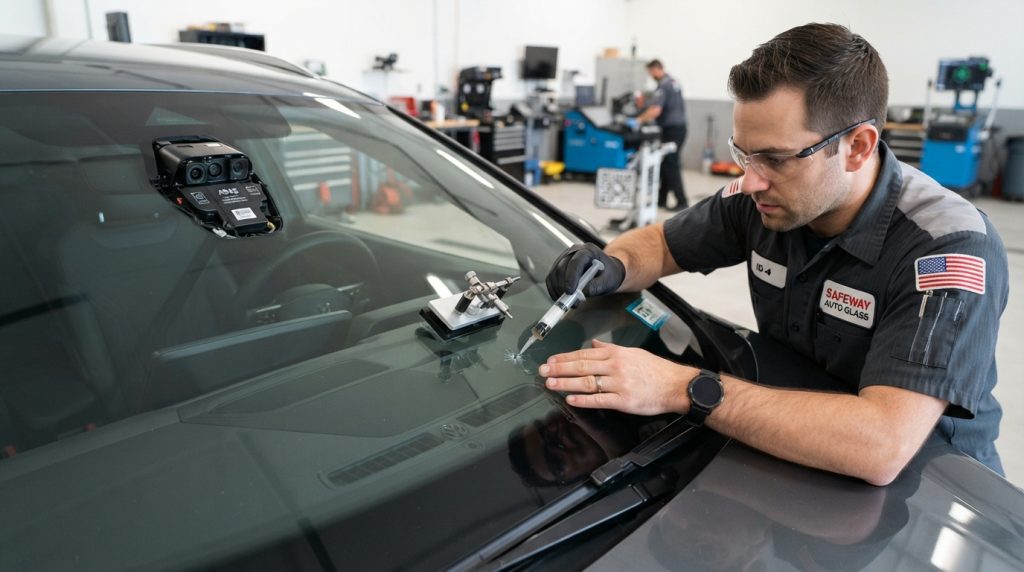
A windshield or collision repair can leave a safety sensor pointing slightly away from where the vehicle expects it to look. ADAS (Advanced Driver Assistance Systems) are vehicle technologies that use sensors and software to support or automate specific driving tasks.
The right method depends on your vehicle and its manufacturer’s instructions, not personal preference. A vehicle can need calibration even when no warning light appears.
Modern vehicles rely on cameras and other sensors to read the road. If glass or vehicle work shifts a sensor, its view may no longer match the system’s expectations.
Knowing which ADAS calibration types apply can help you ask clear questions after a repair. First, it helps to understand what these systems do and why sensor accuracy matters.
Key Takeaways
- The vehicle manufacturer’s procedure determines the required calibration method.
- Static calibration uses targets while the vehicle stays still.
- Dynamic calibration uses information gathered during a prescribed drive.
- Some vehicles require both methods, in a set order.
- A warning light alone cannot confirm calibration status.
What Does ADAS Calibration Do in Your Car?
A forward-facing camera cannot reliably guide a safety feature if its view is no longer aligned with the road. Calibration aligns sensors to the vehicle and its surroundings, so features can use reliable data.
ADAS system calibration is a vehicle-specific alignment process. A system may still turn on when alignment is wrong, yet give inaccurate warnings or responses.
If you ask what ADAS stands for in cars, it means Advanced Driver Assistance Systems. Cameras, radar, LiDAR, and ultrasonic sensors collect information about the vehicle’s surroundings.
Processing units combine those sensor inputs. Actuators carry out actions such as braking or steering, while the human-machine interface presents information to you.
Advanced driver assistance includes features that warn you and features that can act. The table shows how common driver assistance systems use sensor information.
| Feature | What it does | Example sensor input |
|---|---|---|
| Forward collision warning | Alerts to a potential forward collision | Forward-facing camera or radar |
| Lane departure warning | Alerts when the vehicle drifts without signaling | Camera reading lane markings |
| Automatic emergency braking | Can apply brakes if you do not respond in time | Forward-facing camera or radar |
| Adaptive cruise control | Adjusts speed to maintain distance from the vehicle ahead | Forward radar |
Forward collision warning alerts you, while automatic emergency braking can apply the brakes. Adaptive cruise control adjusts speed to maintain distance from traffic ahead.
Lane departure warning detects unintended lane drift by reading lane markings. These features depend on sensors that can judge distance, direction, and the road scene.
Accurate sensing connects the system’s view to the vehicle’s path. That need for accuracy explains why manufacturers use two main calibration approaches.
Which ADAS Calibration Types Can Your Vehicle Use?
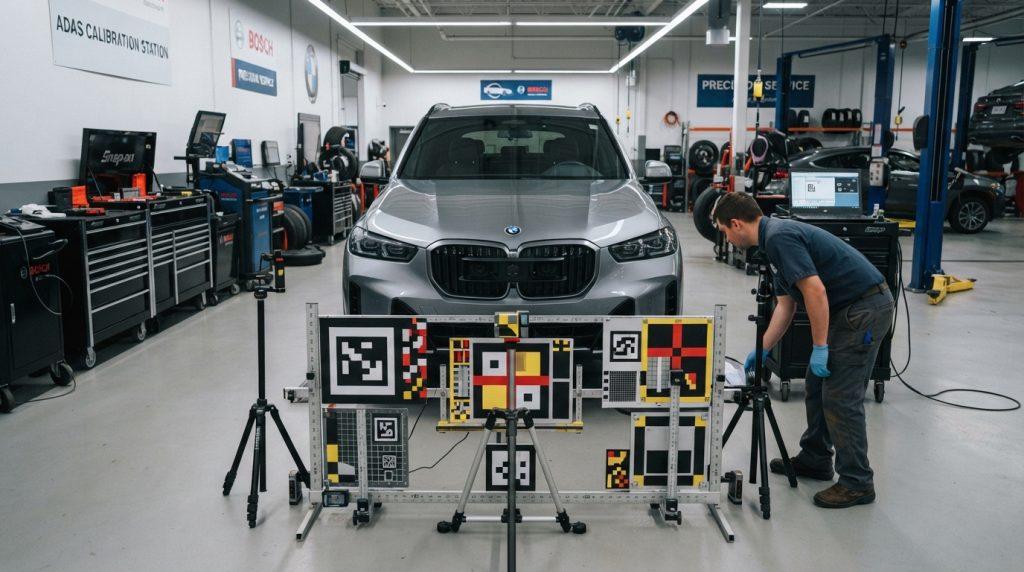
One vehicle may need a carefully measured target setup, while another may need a prescribed drive, and some need both. Your vehicle’s procedure decides which approach applies.
Manufacturer specifications, not preference, set the required method. Static vs dynamic ADAS calibration describes two ways to align sensors, but it does not mean every vehicle can use either one.
Static Calibration Uses Targets in a Controlled Space
Static calibration takes place while the vehicle is stationary in a controlled space. A technician places calibration targets at measured positions set by manufacturer specifications.
The setup may need a level floor and suitable lighting. Reflective surfaces can confuse some sensors, so the work area must meet the procedure’s requirements.
Target placement depends on the vehicle, not a one-size-fits-all measurement. Limited shop space can make it hard to place targets at the required distance and angle.
Static ADAS calibration can give sensors a fixed reference inside the shop. The procedure may also call for checks on vehicle position and setup before calibration begins.
Dynamic Calibration Learns From Road Conditions
Dynamic calibration uses real-world road information during a prescribed drive. A technician follows the vehicle’s instructions, which may set a minimum speed or other driving conditions.
Clear lane markings can matter when a camera must read the road. Poor visibility, bad weather, or missing markings may prevent a suitable drive.
Dynamic ADAS calibration does not mean taking an ordinary trip and assuming the work is done. The route and driving conditions must support the steps listed for that vehicle.
When the system cannot get the needed road information, the procedure may not finish. A technician may need to choose suitable conditions before completing the required steps.
Some Vehicles Require Both Methods
Some vehicle procedures call for shop-based alignment followed by a drive. The static step sets a measured reference, and the road step lets sensors use road conditions.
The order matters when the manufacturer specifies it. A road test alone is not a substitute when the vehicle procedure calls for both steps.
These types adas calibration are not interchangeable options for you to choose by convenience. Your make, model, and repair details guide the required process.
Whether the procedure calls for one method or two, a suitable service must follow it. The next question is what repair work can make calibration required.
Which Repairs Can Make Calibration Required?
A bumper can look like a cosmetic repair while the radar behind it is affected by removal and reinstallation. Calibration required depends on the vehicle’s OEM repair procedures.
A sensor does not have to be replaced for calibration to be required. Work that shifts its position or changes the vehicle’s geometry may affect how a system reads the road.
Windshield, Bumper and Sensor Work Can Shift Alignment
A windshield replacement can affect a forward-facing camera mounted at or near the glass. New glass or changed camera position can alter the camera’s view.
Bumper or grille removal can affect radar sensors mounted behind those parts. Taking a bumper off and putting it back may change radar position, even if the part looks normal.
Sensor replacement can also trigger calibration under OEM repair procedures. The requirement can apply after installation because the system must use the sensor’s position correctly.
Collision repair may involve several parts around cameras or radar. Your repair record can help a technician identify which vehicle-specific procedure applies.
Wheel, Suspension and Structural Repairs Can Change Vehicle Geometry
Wheel alignment, suspension, or steering work can change how the vehicle sits or points. That shift may affect the link between sensor readings and the vehicle’s path.
Structural repairs can also change vehicle geometry. The vehicle’s OEM repair procedures determine whether a check or calibration is needed after that work.
Some software updates can trigger calibration, depending on the manufacturer and model. Battery disconnection can sometimes reset ADAS, but it does not automatically mean every vehicle needs recalibration.
Requirements vary by manufacturer and model, so a general rule cannot replace the repair instructions. Tell the service provider what work was done, including parts removed or adjusted.
Check the vehicle-specific repair procedure before choosing a calibration method. That instruction leads into what a proper service does and how it records the result.
What Happens During Calibration and How Is It Checked?
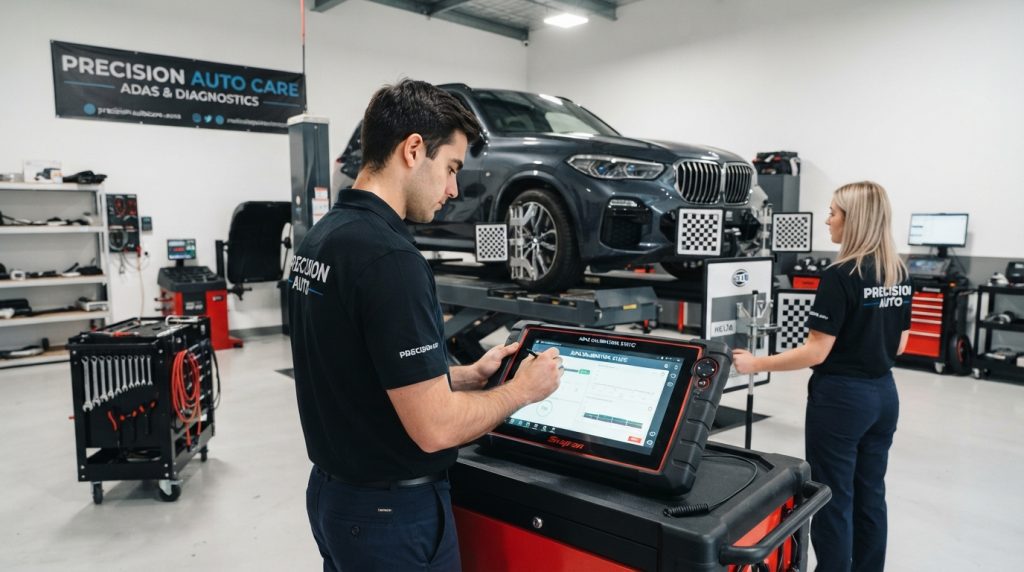
A completed repair is not the same as a verified calibration. The process should follow vehicle-specific instructions and end with a check of the result.
Ask what procedure was done and what record confirms its outcome. A technician may use calibration targets, diagnostic scanners, alignment rigs, and OEM-specific software.
An ADAS calibration machine must suit the vehicle and its procedure. You can ask whether the equipment supports your vehicle’s make and model.
For repair businesses, equipment costs depend on targets, software licenses, vehicle database access, and accessories. Those accessories can include boards, hooks, and stands.
Equipment purchase costs are not the same as a customer’s service price. No standard consumer service price is established here.
Initialization or a scan-tool reset sets up software in certain situations. It does not replace a required static or dynamic calibration.
The workflow below shows what you can ask to have recorded. Scan results, a calibration report, or a service record can help confirm the work.
| Workflow stage | What happens | What to confirm |
|---|---|---|
| Identify procedure | Check the OEM repair procedure | Correct vehicle and repair are recorded |
| Prepare and scan | Connect diagnostic equipment and prepare vehicle | Scan identifies faults or setup needs |
| Calibrate | Follow the required vehicle-specific procedure | Result reports success or an unresolved issue |
| Document | Save scan results, report, or service record | Record is available with repair paperwork |
Keep a record that names the vehicle, work performed, and result. These details make it easier to understand what happened during service.
- Vehicle identification
- Procedure performed
- Success or failure result
- Report or service record
Use the documented result, along with vehicle-specific instructions, to make an informed service and quote decision.
How Can You Choose a Calibration Service and Get a Quote?
Two vehicles with similar-looking glass damage may need different calibration procedures, so start with your vehicle details and repair history. Ask specific questions before agreeing to service.
Choose a provider that follows the vehicle’s OEM repair procedure, uses compatible equipment, and gives you a result record. A search for ADAS calibration near me is only a starting point.
Ask whether the provider can identify the required procedure for your vehicle. Find out whether its equipment supports that make and model.
Ask what paperwork you will receive after the work. A record should show the procedure and whether the result passed or needs more attention.
Have these details ready when requesting a quote:
- Vehicle year, make, and model
- The repair performed
- Whether a camera or sensor was removed or disturbed, if known
- Any ADAS warning displayed
There is no universal ADAS calibration cost, and no consumer price is established here. Ask for a quote based on your specific vehicle and its required procedure.
A generic figure may not reflect whether your vehicle needs one method or more than one. The repair history and vehicle instructions help the provider describe the work in the quote.
After you have those details, you can discuss a suitable service for glass damage. If windshield or other glass damage needs repair, contact a local glass shop for help.
Conclusion
The safest choice is the calibration procedure specified for your vehicle, not a one-size-fits-all method. Check the vehicle-specific procedure after relevant repair work.
A warning light alone does not confirm whether calibration is needed or complete. Ask what work was performed and request a record of the result.
For windshield or other glass damage, you can hire Miracle Auto Glass to fix the damage. Visit us at Bandera Rd & Grissom or call (210) 680-2551.